How big is it, really?
Size is the one thing a photograph cannot tell you. Every image on a shop page is scaled to the same rectangle, so a 20-inch canvas and a 48-inch canvas look identical until one of them arrives. This page fixes that: every size we make, drawn to scale against a six-foot person and against the furniture it is meant to hang above.
Where would you like to start?
Start with a size
You have a size in mind - 24 x 36, say - and you want to know whether that is big.
See all 23 sizes to scale → By furnitureStart with your furniture
You know what it will hang over. Measure the back of it, and we will tell you which sizes fit.
Find sizes by furniture → By shapeStart with the shape
The wall is wide, or narrow, or square, and you want to know which shape it wants.
Compare the six shapes →Whichever route you takeThe three rules
Three numbers decide whether a picture looks right on a wall, and all three are about the furniture beneath it rather than the picture itself. Learn them once and you will not need a size guide again.
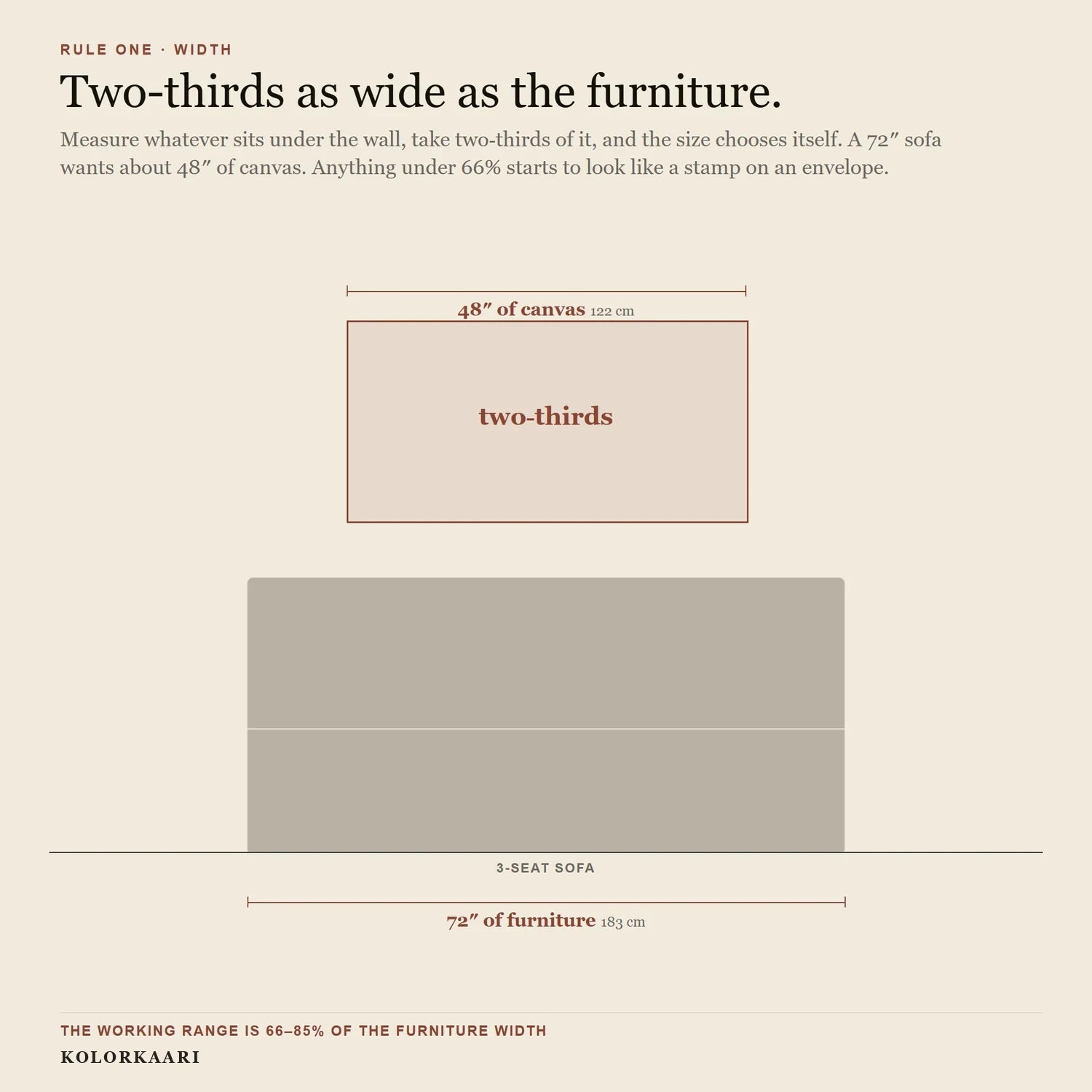
Two-thirds as wide as the furniture
Measure whatever sits under the wall, take two thirds of it, and the size chooses itself. A 72-inch sofa wants about 48 inches of canvas. The working range is 66 to 85 per cent; under 66 the piece reads as a stamp on an envelope, and over 85 it looks like it was measured for a different wall.
Measure the BACK, not the footprint. A diwan is 72 inches at the arms and 51 across the backrest, and the backrest is the thing the picture hangs over. Getting this wrong is the single most common sizing error we see, and it always errs the same way - too small.
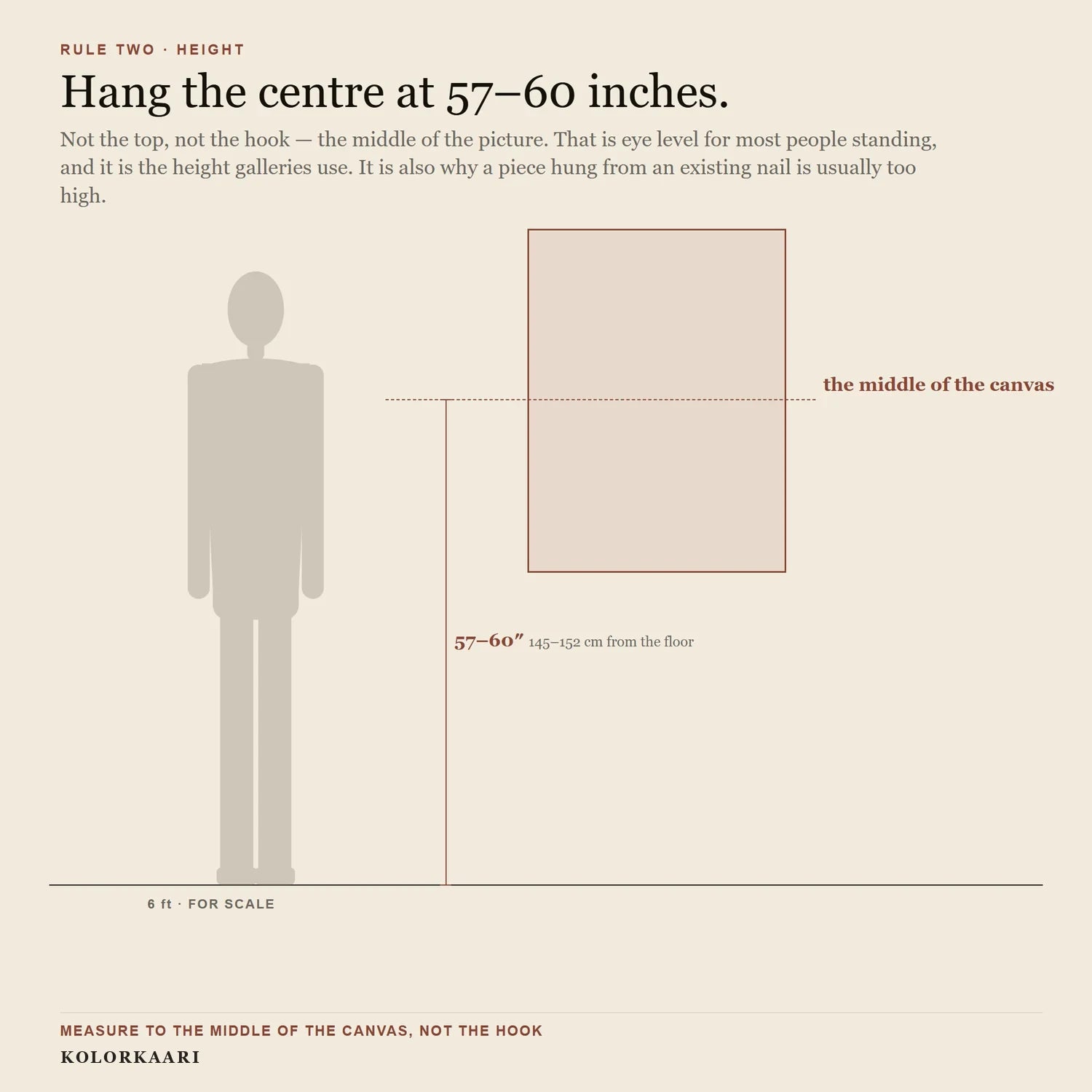
Centre it 57 to 60 inches from the floor
Galleries hang to the centre of the work, not the top or the bottom, and they put that centre at eye level - 57 to 60 inches from the floor for most adults. Measure to the middle of the canvas, not to the hook.
This is the rule people break by hanging too high. If you are unsure, err low: a picture an inch under eye level looks composed, and one six inches over it looks like it is escaping up the wall.
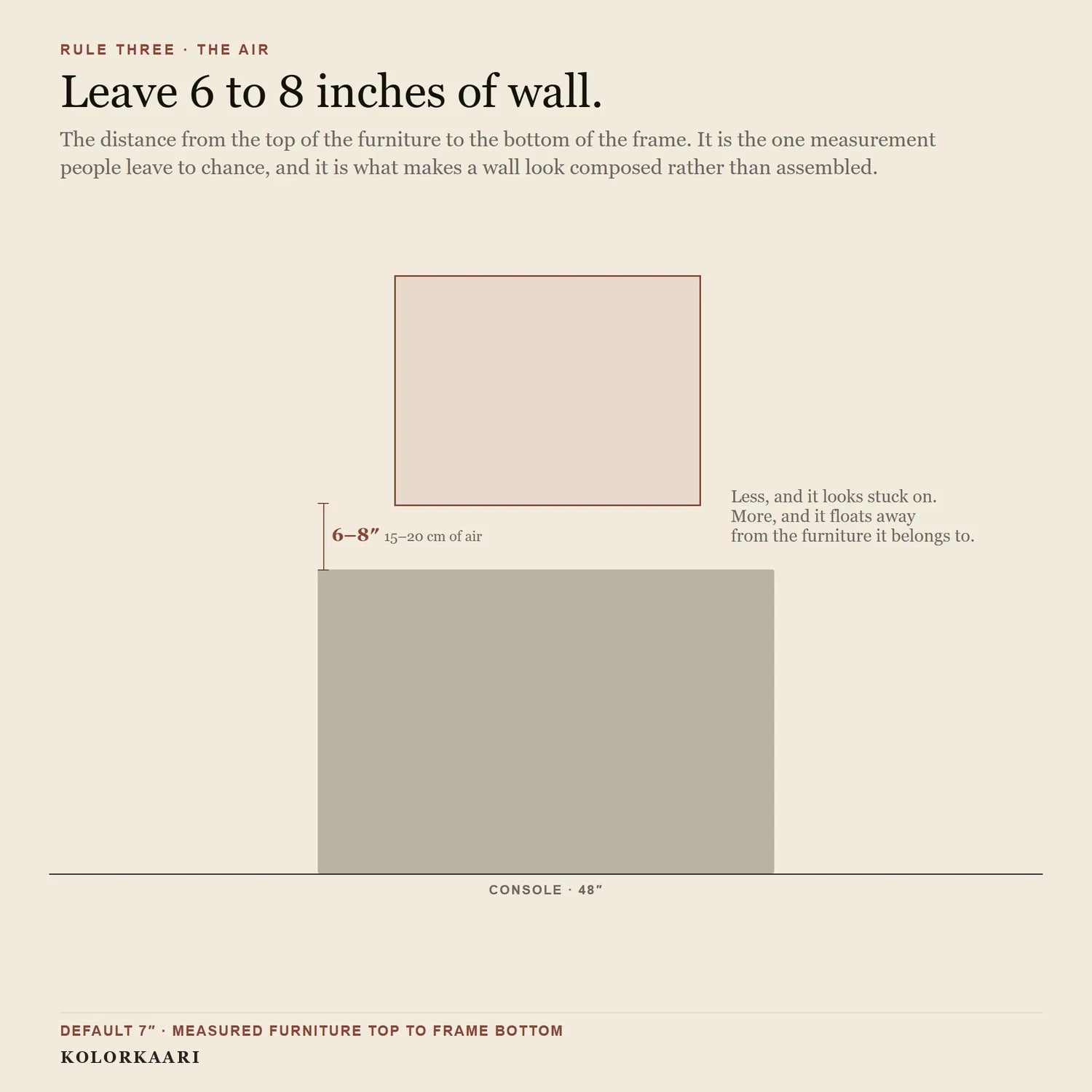
Leave 6 to 8 inches above the furniture
Between the top of the furniture and the bottom of the frame, 6 to 8 inches reads as one arrangement. More than that and the picture and the furniture become two separate objects that happen to share a wall.
When the two rules disagree - a low chowki that would put the centre at 30 inches - the GAP wins, up to a point. Anchor the piece to the furniture and let the centre fall, but not below about 42 inches, which is roughly the top of a dining chair. Under that it stops reading as wall art and starts reading as something propped up.
Every canvas is printed and stretched to order.
Which means a size outside the ladder is a scheduling question, not a manufacturing one. Send us the width of the furniture and a photograph of the wall, and we will come back with a size, a price and a lead time.
AnswersQuestions
What size canvas is best for above a sofa?
For a standard three-seat sofa - 72 to 84 inches wide - a canvas around 48 inches wide is right: a 48 x 24, a 48 x 32 or a 48 x 36. The rule is two thirds to four fifths of the sofa's BACK, which is narrower than the sofa's overall width. Hang it 6 to 8 inches above the back cushions.
How high should I hang a canvas?
Centre the canvas 57 to 60 inches from the floor - that is eye level for most adults, and the height galleries hang to. Measure to the middle of the canvas, not to the top of the frame or to the hook. Where the picture sits above furniture, the 6 to 8 inch gap takes priority and the centre may fall as low as about 42 inches.
Is 24 x 36 inches big?
24 x 36 inches is 61 x 91 cm - about waist to shoulder on a six-foot person, and roughly the size of a wide open newspaper. It is large enough to be the subject of a wall on its own and small enough to hang above a side cabinet without a second piece.
What size is a 48 x 24 canvas in centimetres?
48 x 24 inches is 122 x 61 cm. It is our most-recommended panoramic: four feet of canvas, wide enough to hold a sofa wall or a bed wall by itself, and low enough at two feet tall to stay well clear of a standard 80-inch door header.
Should I choose the bigger size or the smaller one?
Almost always the bigger one. Under-sizing is the commonest mistake in wall decor and the one people regret - a piece at less than two thirds of the furniture beneath it looks like a stamp on an envelope. If your measurement falls between two sizes in the ladder, take the larger, unless doing so pushes the top of the frame above the door header.
How do I measure my wall for a canvas?
Measure the furniture, not the wall. Take the width of the BACK of whatever sits beneath the wall - the backrest of a diwan, the board of a headboard, the top of a console - and multiply by 0.66 and 0.85. Any size in that band will look right. Then check the height: the top of the frame should sit below the door header, about 80 inches.
What if none of your sizes fit my wall?
Write to us. Every canvas is printed and stretched to order, so a size outside the ladder is a scheduling question rather than a manufacturing one. Send the width of the furniture and a photograph of the wall and we will come back with a recommendation and a price.
Do the sizes include the frame?
No. Every size on this page is the CANVAS. A premium floater frame adds about 1.4 inches to each dimension - 10 mm of face plus a 6–8 mm gap on all four sides. That is allowed for in the drawings on this page.
Are the furniture pieces shown to scale?
Yes. Every drawing on this page is built at a single pixels-per-inch, and each piece of furniture is a photographic cut-out trimmed so that its pixel width corresponds to its real width. Nothing on the page is scaled independently of anything else - that is the only reason the comparisons are worth looking at.
Can I hang a canvas without a hook or nails?
Every canvas ships with a sawtooth hanger already fitted to the top bar, so a single nail or wall hook is enough for sizes up to about 36 inches. For 40 inches and above, use two fixings spaced a third of the width in from each edge - it stops the piece drifting out of level over time.
AttributionHow these drawings are made
Every drawing on this page is built at one pixels-per-inch. The furniture is photographic, trimmed so that its pixel width corresponds to a known real width, and the artwork rectangles are placed at the same scale - so the proportions are correct by construction rather than by eye. The reference figure is drawn rather than photographed on purpose: a photograph of a person is a photograph of a SPECIFIC person, and every detail of them is a claim about who this shop is for that nobody meant to make. A silhouette says “an adult of average height” and nothing else.
The placement numbers - two thirds to 85 per cent of the furniture, a 6 to 8 inch gap, a centre 57 to 60 inches from the floor, a top below the 80-inch door header - are conventions from interior practice rather than physical constants. They are the numbers designers work to. Every pairing shown on this page has been checked against all four, and any pairing that failed was changed rather than published.
Furniture shown throughout is for scale only and is not included with any canvas. Centimetre conversions are rounded to the nearest centimetre.