Floater Frame
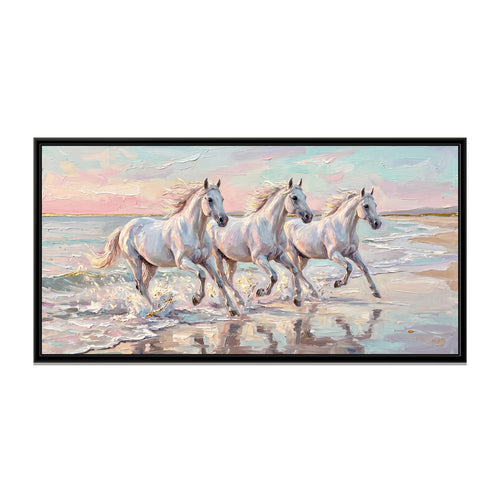
A floater frame holds the canvas from behind. The picture sits inside the frame rather than under its lip, so a narrow shadow gap runs all the way round and the canvas seems to float in the opening. Nothing covers the edge of the picture, and there is no glass in front of it.
| Moulding | Polystyrene, light on the wall |
| Face | 10 mm |
| Gap | 6–8 mm, all round |
| Depth | 35 mm |
| Stretcher inside | Solid pine, 25 mm |
The numbers are the same for every finish. Choosing a finish is a choice of colour only.
The four finishes

Natural
10 mm face · 6–8 mm gap · 35 mm depth
A pale, light wood-tone finish. It reads as a border rather than a frame, which suits a picture that already carries a lot of colour.

Antique gold
10 mm face · 6–8 mm gap · 35 mm depth
A warm, softened gold rather than a bright gilt. It picks up ochres and reds, and of the four it looks the most formal from across a room.

Walnut
10 mm face · 6–8 mm gap · 35 mm depth
A deep brown wood-tone finish. It sits easily beside teak and sheesham furniture without trying to match it, and gives weight to a lighter picture.

Matt black
10 mm face · 6–8 mm gap · 35 mm depth
Flat, not glossy, so it does not throw light back. The quietest of the four: it draws a clean edge round the picture and steps out of the way.
What the back looks like

The sawtooth hanger is fitted before the canvas is packed. One screw or picture hook and it is up.

The canvas is stapled under tension behind the pine bar, so the face stays flat and even.
Prefer no frame? See the wrapped canvas. For sizes, see the size guide.