Started with a paintbrush. Kept the paintbrush.
Kolor + kaari.
From kaarigari — कारीगरी — craftsmanship. The word carries an expectation in Hindi that "craft" has lost in English: that the maker's hand should be findable in the made thing.
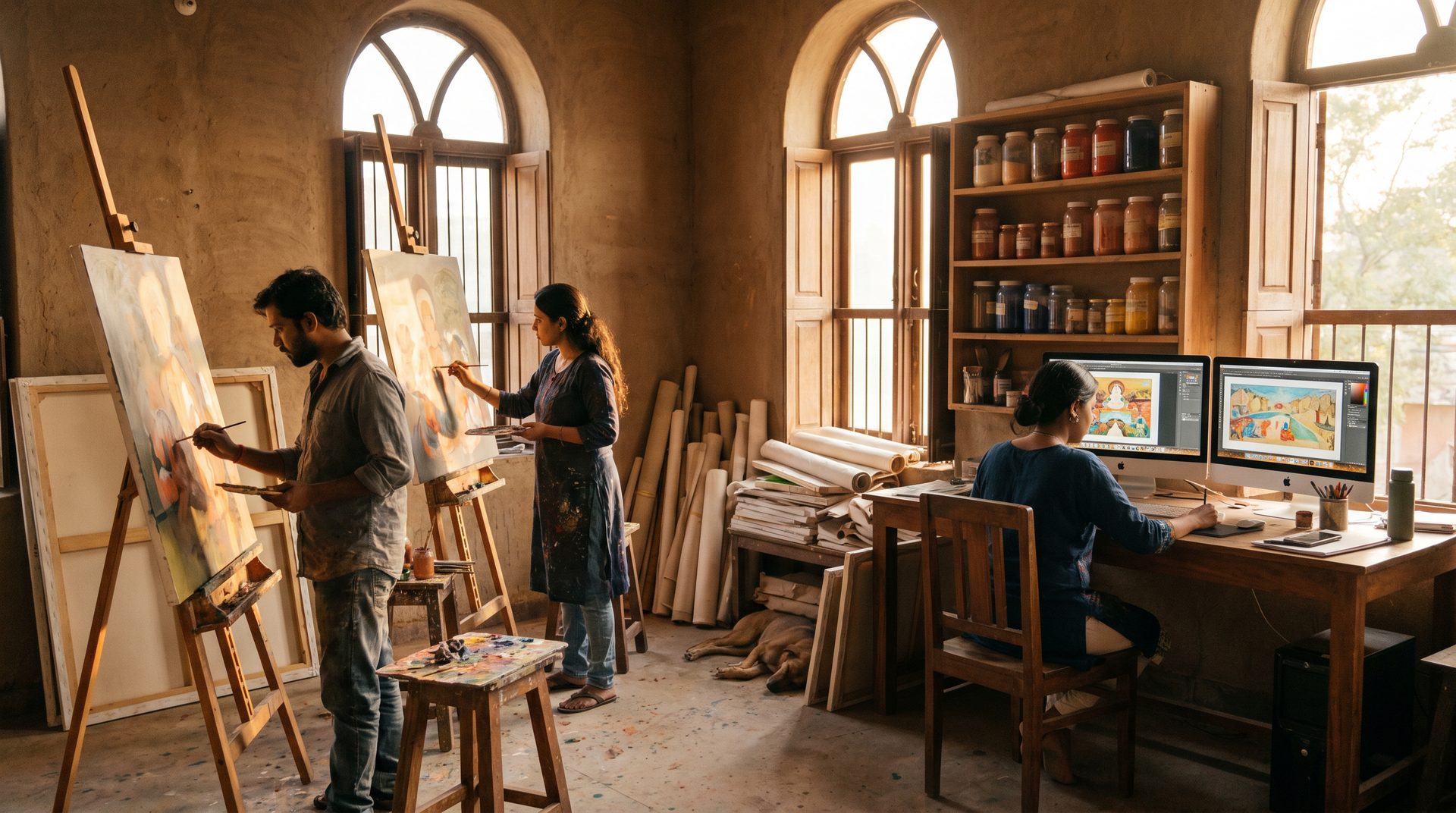
Kolorkaari began in 2018 as exactly what it sounds like — a paintbrush, a wall, and a commission that took three weeks longer than promised because the wall deserved it. The work spread the way mural work does: one finished wall recruits the next client.
The screens arrived around the third year, when a client in another country wanted our wall and we couldn't ship a scaffold. So we designed it, proofed it against our own pigments, and had it printed and installed there. It held up. The design bench has been part of the studio ever since — not a pivot, an extra hand.
Independent artists. One standard.
Kolorkaari isn't an agency with employees; it's a working collective of independent Indian artists and designers who choose each wall they take. The disciplines around the benches:
-
Muralists
The wall-painters. Trained hands across botanical, folk and abstract idioms; comfortable on scaffolding, patient on day eleven of a fourteen-day detail pass.
-
Tradition specialists
Artists carrying Pichwai and Lippan vocabularies — lotus and cattle iconography, clay relief, mirror inlay — into rooms those traditions never expected to visit.
-
Colourists
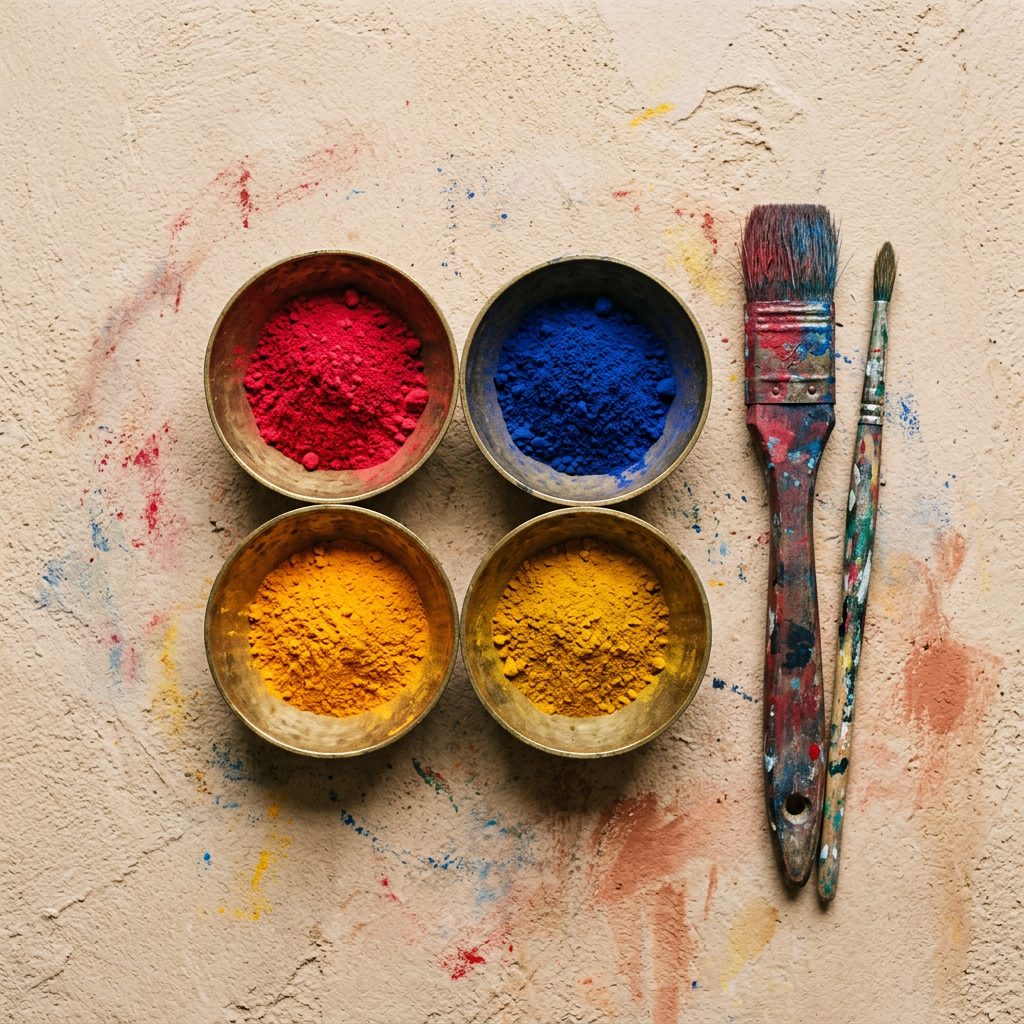
The keepers of rang. They mix the palettes, match digital proofs to physical pigment under two kinds of light, and veto any colour that only works on a screen.
-
Digital designers
The screen bench. They compose murals at true wall proportion, build print-resolution artwork, and treat the stylus the way the muralists treat a fine brush — as a hand tool.
-
Production hand
The one who argues with printers and fabricators until the proof strip matches the swatch. Approves every physical proof before a full run. Has never lost the argument.
-
Site lead
Plans the install — seams away from eye lines, night shifts on live commercial sites, the furniture carried back in the morning after the reveal.
India-based, all of us. The work travels further than we do — painted on site where we can come to the wall, designed and fabricated where we can't.
What we hold to.
- i.
The brush didn't retire when the screen arrived. They share a workbench. A studio that drops one hand to pick up the other has halved itself.
- ii.
The wall chooses the method. Not nostalgia, not novelty, not the higher invoice. We've talked clients out of brushwork and out of prints in the same week.
- iii.
Colour is a material before it is a number. Every hex on every proof traces back to a pigment in a bowl. Screens lie; walls don't.
- iv.
Show the middle days. Sketch, grid, the stage where the wall looks wrong. Trust is built in plain sight or not at all.
- v.
Leave the wall better armed than we found it. Touch-up pigment, labelled. A care note. A phone number that still answers in year five.